

Preview
Description
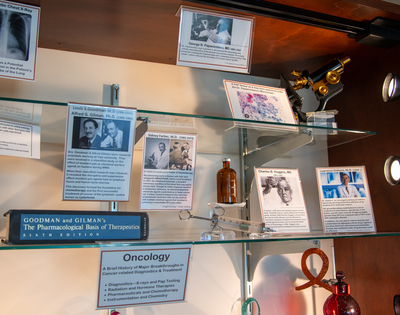
The upper two shelves on the right provide illustrative mini biographies for 6 pioneers in Oncology research and practice from the modern era. Drs. Louis S. Goodman and Alfred G. Gilman were research scientists during WW II. Their classified research led them to a more comprehensive understanding of the Human body’s immune system with focus on the lymphatic system. Goodman and Gilman authored the definitive textbook for guiding pharmacology practice in the treatment of cancer and related diseases in the 20th century. The sixth edition of this text is displayed below their storyboard. The Father of Chemotherapy, Dr. Sidney Farber, is featured to the right his landmark studies on childhood leukemia led to a remarkably successful treatment regimen for this particular cancer type. A brown glass multidose vial and glass syringe represent the signature treatment artifacts for chemotherapy.
Above the first shelf is a mini-biography for Dr. George N. Papanicolaou. His understanding and subsequent description of the female reproductive system led to an essential diagnostic test for cervical cancer known today as the “PAP smear”, in his honor. An image of a stained microbiological slide representing a PAP smear along with a microscope from Dr. Papanicolaou’s era is positioned to his right, on the corner of the top the shelf.
A mini-biography for Nobel laureate, Dr. Charles B Huggins, describing his hormonal treatments for prostate cancer are featured. He was honored with the award for physiology research in 1966. Finally, Dr. Lawrence Einhorn, from Indiana University, is featured due to his development of the unique three-drug regimen for successfully treating testicular cancer.
Media Type
JPG
Keywords
Museum of Medical History, special collections, image gallery, Gulf Coast Medical Center